Message-Market Fit: Why Some Speakers Get Booked at $20,000 and Others With the Same Topic Don’t

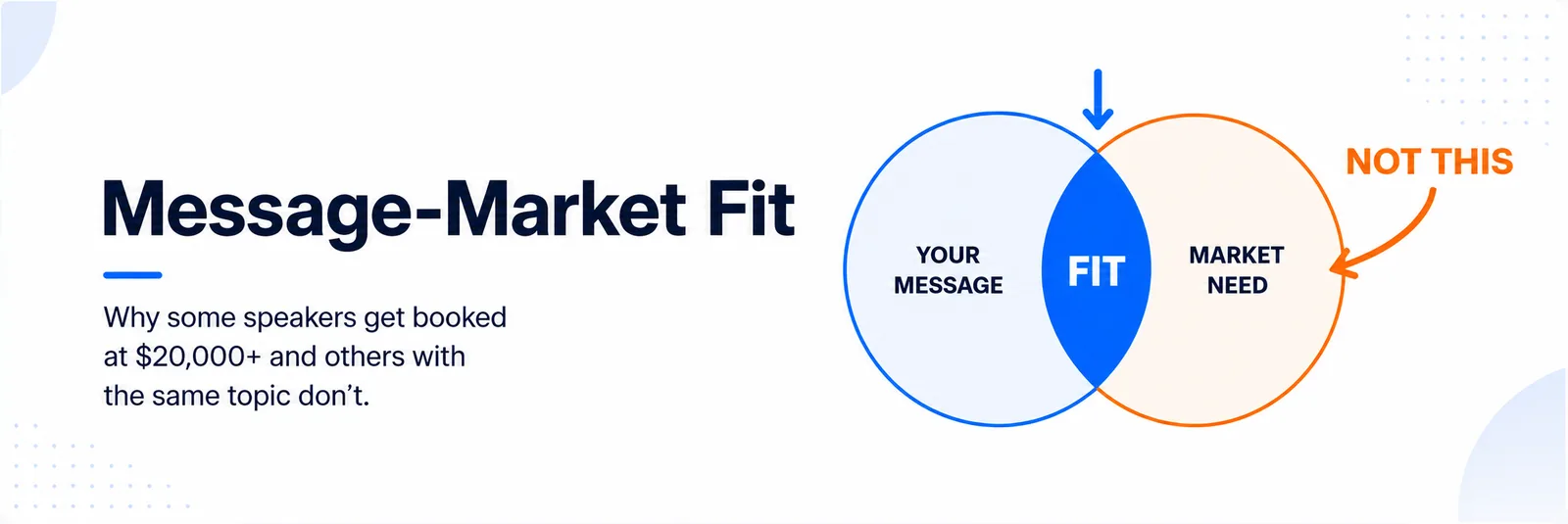
A recent Talkadot training with Aaron Knipp from Cicospace surfaced something I have watched play out for over 20 years in the speaking business.
The speakers who consistently get paid well, especially in the $20,000+ range, tend to know four things with unusual clarity:
Who they serve.
What problem they solve.
What audience they are not for.
And the transformation their message creates.
That sounds simple.
It is not.
Because most speakers think they are looking for a better topic.
They are not.
They are looking for message-market fit.
That phrase borrows from the startup world. In startups, product-market fit is the moment a product meets a market need so clearly that demand starts pulling the product forward. Sales get easier. Referrals become more natural. The market begins to recognize itself in the solution.
For speakers, the same thing happens with a message.
When your message has market fit, sales conversations feel less like persuasion and more like recognition.
The buyer does not just understand what you speak about.
They feel the problem.
They can picture their audience.
They can repeat your value to their committee.
They know why this message matters now.
That is the part many speakers miss.
A speaker does not get booked because they have a topic.
They get booked because an event organizer can connect that topic to a real audience need, inside a real organizational moment, with enough confidence to say, “This is the one.”
The Gratitude Problem
Here is where it gets strange.
Two speakers can both speak on gratitude.
One struggles to get booked.
The other gets booked constantly.
Same topic.
Completely different market response.
So the answer cannot simply be, “Pick a better topic.”
Gratitude might be framed as a pleasant inspirational talk.
Or it might be framed as the missing emotional operating system for healthcare workers facing compassion fatigue.
Or as a leadership behavior that reduces burnout and improves retention.
Or as a sales culture reset after a brutal year of rejection.
Or as a way to rebuild trust in an organization that has been through layoffs, mergers, or conflict.
Those are not the same message.
They may all use the word gratitude, but they are not solving the same buyer problem.
That is the nuance.
Event organizers are rarely buying the abstract topic.
They are buying the fit between the topic, the audience, the pain, the timing, and the outcome.
A generic gratitude talk sounds nice.
A gratitude keynote that helps exhausted association members reconnect with purpose after three years of industry disruption feels urgent.
Same word.
Different market.
The Buyer Is Not Asking, “Is This Interesting?”
This is where speakers often misunderstand event planners, directors of education, and association executives.
The buyer is not simply asking:
“Is this a good speaker?”
They are asking something more complicated:
“Will my audience care?”
“Will this feel relevant to the moment we are in?”
“Can I explain this clearly to my committee?”
“Will this make our event feel smarter, fresher, more useful, or more energizing?”
“Will people leave saying, ‘I needed that’?”
That is why message-market fit matters so much.
A speaker may have a strong idea, a beautiful website, a polished reel, and impressive credentials, but if the buyer has to do too much work to connect the dots, the message is not doing its job yet.
The buyer should not have to translate your brilliance into their context.
Your message should arrive already shaped for the market you want to serve.
The Hidden Difference Between a Topic and a Market-Fit Message
A topic is what you talk about.
A market-fit message is why a specific audience needs to hear it now.
That is the difference.
“Leadership” is a topic.
“Helping first-time managers lead former peers without losing trust” is closer to a market-fit message.
“Change” is a topic.
“Helping association executives keep members engaged when the old value proposition no longer feels obvious” is closer to a market-fit message.
“Storytelling” is a topic.
“Helping technical leaders explain complex ideas so executives fund them faster” is closer to a market-fit message.
The more specific version does not make the message smaller.
It makes it easier to buy.
This is one of the counterintuitive parts of speaking.
Many speakers stay broad because they are afraid specificity will limit them.
But buyers do not experience broadness as opportunity.
They experience it as fog.
Specificity gives them something to hold.
The $20,000 Answer
The question that came up in the conversation was:
How does a speaker find their $20,000 answer?
I do not think the answer is to sit in a room and invent a clever positioning statement.
That is where a lot of speakers get stuck.
They try to “find their niche” as if it is hiding somewhere in a notebook.
But the strongest speaker messages usually come from the intersection of three things:
- What you know deeply.
- What a specific audience urgently feels.
- What buyers can justify paying to solve.
You need all three.
If you only have what you know deeply, you have expertise.
If you only have what an audience feels, you have empathy.
If you only have what buyers will pay for, you have a sales angle.
Message-market fit happens when those three overlap.
That is where the $20,000 answer usually lives.
Not in a trend.
Not in a clever title.
Not in whatever topic is hot this year.
It lives in the place where your lived expertise meets a painful, timely, buyer-recognized need.
Go With What You Know Deeply
This is the part that feels almost too obvious, but it is where many speakers drift.
They look outward first.
What are people booking?
What is trending?
What topics are hot?
What do event planners want right now?
Those are useful questions, but they are dangerous as the starting point.
Because if you chase the market without anchoring in what you know deeply, your message starts to sound borrowed.
It may be polished.
It may even sell a little.
But it will not have the kind of depth that makes buyers trust you at a premium level.
The strongest speakers often do the opposite.
They start with what they understand better than most people because they have lived it, studied it, taught it, built it, failed through it, or watched it up close for years.
Then they ask:
Where does this knowledge solve a real problem?
Who is already feeling that problem?
Who has budget attached to that pain?
That sequence matters.
Depth first.
Market second.
Message third.
When you reverse it, you get generic positioning.
When you honor it, you get something that feels earned.
The Recognition Test
You know a speaker message is starting to fit the market when the sales conversation changes.
The buyer stops needing a long explanation.
They start saying things like:
“That is exactly what our people are dealing with.”
“I can see why this would fit our audience.”
“That language is helpful. I need to share that with my team.”
“We have been trying to say this internally, but not that clearly.”
Notice what is happening.
The speaker is no longer pushing.
The buyer is recognizing.
That is the difference between a message that sounds impressive and a message that fits.
A market-fit message gives the buyer words for a problem they already had.
That is why it feels so powerful.
It does not create demand from scratch.
It reveals demand that was already there.
What Event Organizers Value
From the event organizer’s side, this is incredibly practical.
Directors of education and annual conference planners are constantly trying to translate audience needs into programming decisions.
They are not just filling slots.
They are curating meaning.
They are asking:
-What does this audience need right now?
-What will feel fresh but not random?
-What will be practical but not boring?
-What will stretch people without losing them?
-What will make the event feel worth attending?
A speaker with message-market fit makes that job easier.
They do not just say, “I speak on resilience.”
They say, “I help burned-out healthcare leaders rebuild energy without pretending the last few years were normal.”
They do not just say, “I speak on innovation.”
They say, “I help association leaders spot where legacy thinking is quietly blocking member growth.”
They do not just say, “I speak on communication.”
They say, “I help technical teams explain high-stakes ideas so nontechnical decision-makers can act.”
Those messages are easier to evaluate because they contain the buyer’s real question inside them.
Who is this for?
What problem does it solve?
Why now?
What changes after the session?
The Five Signals of Message-Market Fit
It is not enough to say, “You know it when you have it.”
There are signals
Signal 1. Buyers repeat your language
When event organizers start using your words back to you, your message is becoming portable.
That matters because most speaker decisions are not made by one person alone. Your message has to survive being repeated to a committee, board, executive director, sponsor, or planning team.
Signal 2. The audience problem becomes obvious quickly
If you need 15 minutes to explain why the issue matters, the fit is not sharp enough yet.
A market-fit message makes the pain visible in one sentence.
Compare:
'I speak about how teams can embrace changing environments.'
vs.
'I help leadership teams stop losing their best people in the first six months after a reorg.'
The first one needs scaffolding. The second one walks in the room with the problem already drawn on the wall.
Signal 3. Referrals get more specific
Weak referral: “You should check out this speaker. They are great.”
Stronger referral: “You need to talk to this person. They help membership teams rethink engagement when younger members are not joining the way they used to.”
Specific referrals are a sign the market knows where to place you.
Signal 4. Price resistance changes
Not disappears.
Changes.
Premium speakers still get negotiated.
But when the fit is obvious, the buyer is less likely to compare you as a generic “speaker” and more likely to see you as the person who solves this particular programming problem.
Signal 5. Your no becomes clearer
This may be the most underrated signal.
When you have message-market fit, you know what you are not for.
You stop trying to stretch every inquiry into a fit.
That clarity builds trust.
Event organizers can feel when a speaker is trying to make themselves fit everything.
They can also feel when a speaker knows exactly where they create value.
The Bigger Point
The speaking market does not reward topics evenly.
It rewards messages that match real buyer needs.
That is why two speakers can talk about the same subject and get completely different results.
The difference is rarely just the website.
Rarely just the video.
Rarely just the title.
Those things matter, but they are amplifiers.
They amplify the message underneath.
If the message is fuzzy, a better website amplifies the fuzziness.
If the message fits, the website, reel, sales call, and referral all become easier.
That is the hidden architecture behind many premium speaking businesses.
They are not simply better at explaining what they do.
They have found a market that recognizes itself in the explanation.
That is message-market fit.
And for speakers trying to find their $20,000 answer, the goal is not to sound more impressive.
The goal is to become easier to recognize.
Because the best sales conversation is not the one where you convince the buyer they have a problem.
It is the one where they hear your message and realize you have been describing their problem all along.