The Hidden Architecture Behind World-Class Keynotes
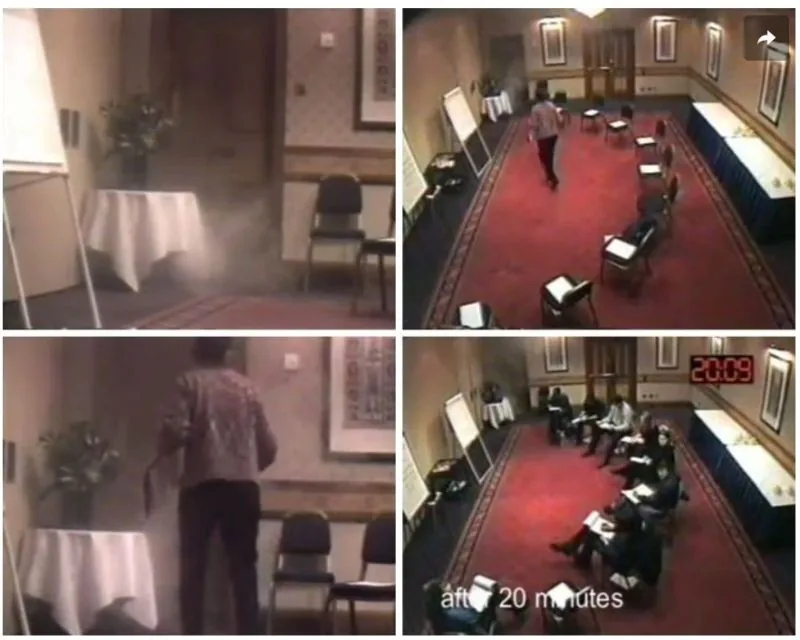
In the late 1960s, psychologists Bibb Latané and John Darley ran one of the strangest experiments in social psychology.
They put people in a room and asked them to fill out a questionnaire.
Then smoke began seeping into the room.
When people were alone, most got up and reported it.
But when they were placed in the room with two people who calmly ignored the smoke, most stayed seated. In the classic version of the study, 75% of people reported the smoke when they were alone. Only 10% reported it when two passive people in the room acted like nothing was wrong.
Think about that.
They could see the smoke.
They could smell it.
They knew something was off.
But they looked around, saw no one else reacting, and quietly adjusted their own interpretation of reality.
This is the part that matters for keynote speakers.
A lot of audiences are sitting in their own version of that room.
They know something is off.
They know their industry is changing.
They know their team is tired.
They know their old way of working is not working.
They know they need to have a harder conversation, make a braver decision, or think differently about what comes next.
But they are waiting for permission.
Not because they are weak.
Because humans are social creatures. We often need someone to name what we are already sensing before we feel allowed to act on it.
That is one of the least understood jobs of a great keynote.
A great keynote does not just deliver information.
It gives the audience permission.
Simple Is Not Basic
I have been studying what makes certain keynote speakers not just good on stage, but easy to book, easy to refer, and easy to remember.
From the outside, many of their topics look almost basic.
Leadership.
Change.
Trust.
Resilience.
Gratitude.
Communication.
Confidence.
Culture.
Nothing about those words feels especially groundbreaking.
But then you watch the best speakers work, and you realize the idea is not basic.
It is simple.
And simple is harder than it looks.
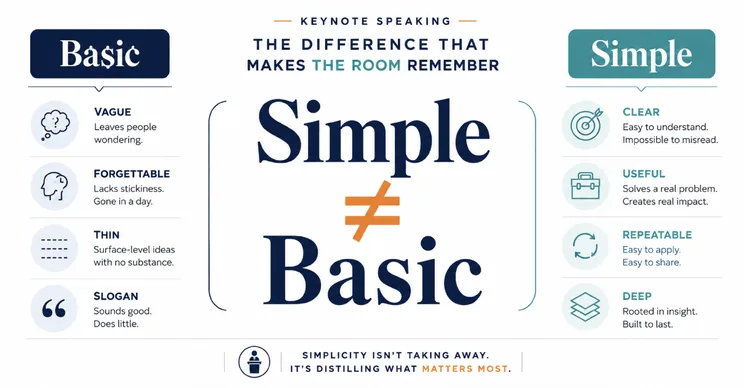
Basic means obvious and thin.
Simple means clear and deep.
Basic says, “Be more resilient.”
Simple says, “Here is why you have been interpreting pressure the wrong way, and here is a way to move through it that you can remember when pressure hits again.”
Basic gives people a slogan.
Simple gives people a new way to see.
That distinction matters because audiences do not need more information. They are drowning in information.
What they need is a moment of recognition.
They need to feel:
“Oh. That is what has been happening.”
“That is why this has felt so hard.”
“That is the thing I have been avoiding.”
“That is the permission I needed.”
But if the keynote stops there, it is incomplete.
Permission opens the door.
And a framework gives people a way to walk through it.
The Two-Part Structure
At the center of most great keynotes are two ingredients:
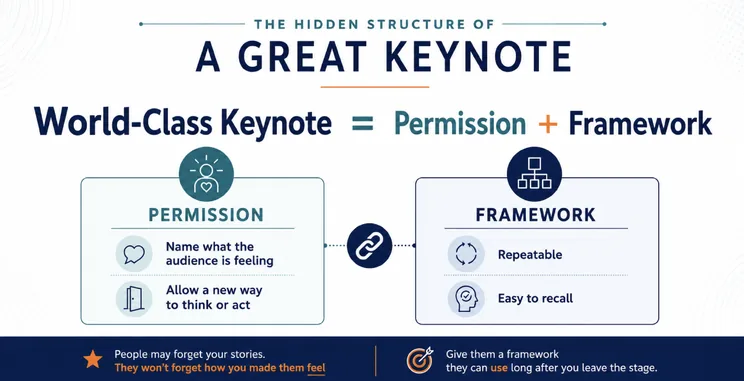
Permission and framework.
Permission answers:
“What am I now allowed to believe, feel, name, or do?”
Framework answers:
“How do I actually live this out after the applause is over?”
You need both.
A keynote with permission but no framework can feel powerful in the moment and disappear by Monday.
The audience leaves inspired, but not equipped.
They felt something, but they cannot repeat it.
They saw something, but they cannot use it.
A keynote with framework but no permission can feel practical but flat.
The audience gets steps, but the steps do not feel urgent.
They understand the model, but they do not feel personally invited into it.
World-class keynotes do both.
They shift what the audience feels allowed to see.
Then they give them a repeatable way to act on what they now see.
That is the hidden structure.
What Permission Looks Like
Permission is not always dramatic.
Sometimes it is subtle.
A speaker gives leaders permission to admit that constant change is exhausting without making them feel weak.
A speaker gives salespeople permission to stop chasing every lead and focus on the few conversations that actually matter.
A speaker gives educators permission to care deeply without carrying every student’s outcome as a personal failure.
A speaker gives association members permission to question an old industry habit that everyone privately knows is outdated.
A speaker gives managers permission to have the conversation they have been delaying.
The best version of this does not feel like the speaker is telling the audience what to think.
It feels like the speaker is saying out loud what the room already knew but had not yet organized.
That is why permission is so powerful.
It creates shared reality.
In the smoke-filled room, the problem was not that people lacked eyes.
The problem was that they lacked a social signal that their interpretation was valid.
Great keynotes provide that signal.
They say:
“Yes, you are seeing what you think you are seeing.”
“Yes, this matters.”
“Yes, you are allowed to act differently now.”
But Permission Alone Is Not Enough
This is where many keynotes lose the magic.
They create the realization.
They get the heads nodding.
They make people feel seen.
They give the audience language for what has been happening.
And then they stop.
The audience leaves with emotion but not architecture.
That may still get applause.
It may still get a nice line of people afterward saying, “That was amazing.”
But six months later, what remains?
Can they repeat the idea?
Can they use it in a meeting?
Can they teach it to someone else?
Can they remember the decision rule when the old habit returns?
That is the test.
A great keynote needs a framework that survives the room.
What A Framework Really Does
A framework is not a long acronym.
It is not a complicated model with twelve steps and seven sub-steps under each step.
It is not a clever diagram that only makes sense while the speaker is explaining it.
A real framework is a portable way to think.
It gives the audience a handle.
Something they can grab when the moment comes back.
The best frameworks are easy to recall and hard to outgrow.
They are simple enough to remember, but rich enough to keep using.
That is why “simple but not basic” matters so much.
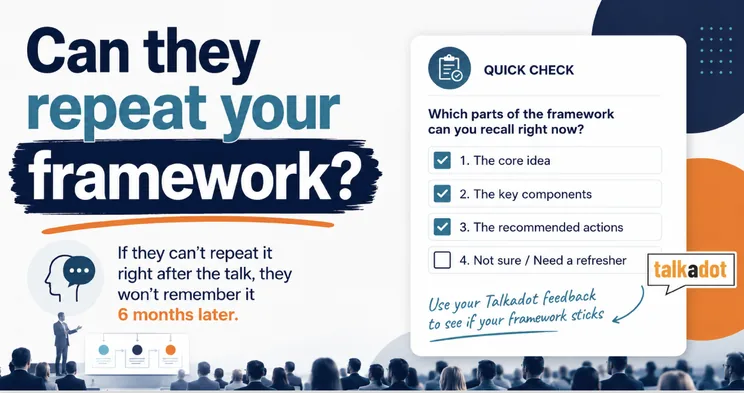
If the audience cannot repeat the framework right after the talk, they will almost certainly not remember it six months later.
That does not mean every person needs to remember every word.
But they should remember the shape of the idea.
The question.
The steps.
The contrast.
The lens.
The phrase that unlocks the behavior.
That is what turns a keynote from a performance into a tool.
Cassandra Worthy, a 7-figure professional speaker and author of Change Enthusiasm, wrote in Entrepreneur that people often assume great speakers win because of energy, stories, or emotion. Those matter, she says, but the thing people miss is that the best speakers have the best frameworks.
You Can See This In The Speakers People Remember
Once you start looking for permission and framework, you see it everywhere.
Let's look at two well known and clear examples of this playing out.
Take Mel Robbins.
Her core idea, the 5 Second Rule, is almost absurdly simple from the outside: count backward from five and move. But the permission underneath it is powerful: you do not have to wait until you feel motivated, confident, or ready. You can act before your feelings catch up. Then the framework is instantly repeatable: 5-4-3-2-1, go. She says the rule helps interrupt self-doubt, negative self-talk, and hesitation so people can take action.
That is simple.
It is not basic.
Or take Simon Sinek
“Start With Why” works because it gives leaders permission to stop leading with what they do and start with why it matters. The framework is the Golden Circle: Why > How > What. He describes the Golden Circle as a way to explain why some leaders and organizations inspire while others do not, beginning with the question of “Why?”
Again, simple.
But not basic.
The Repeatability Test
One of the simplest ways to test whether your framework is working is to ask the audience.
Not vaguely.
If you want to see how stick your framework is, at the end of your talk ask your audience for feedback using Talkadot and in your survey, add a custom question that reads like this:
Ask them "What was the framework from today’s keynote?"
That answer is revealing.
If your audience can't repeat your framework directly at the end of your presentation, there is no chance they will successfully implement it on Monday at work.
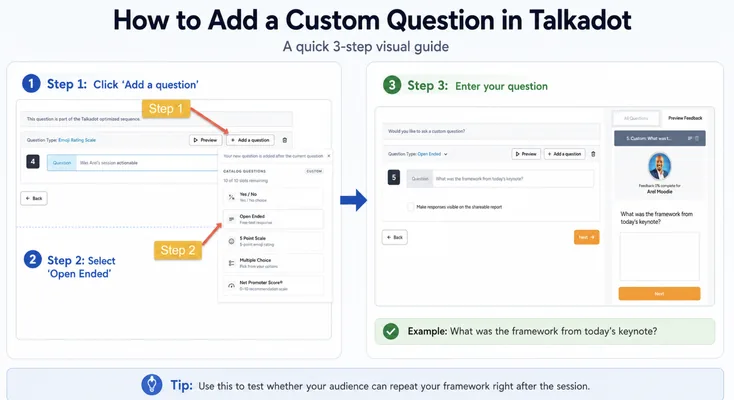
(Try it out and let me know how it goes, seriously, oh and you can always hide the answers to this question from showing up your public report by keeping the "Make responses visible on the shareable report" unchecked, so it's just info for you to get better as a speaker.)
After you do this, see if the answers are clear and consistent, that means the framework is landing.
If the answers are scattered, vague, or mostly emotional, the talk may have moved people without equipping them.
That is not failure.
It is feedback.
It tells the speaker where the talk needs to get simpler.
Not shallower.
Simpler.
The Meat and Potatoes of a Keynote
Stories matter.
Humor matters.
Presence matters.
Emotion matters.
Connection matters.
A great keynote without those things usually feels like a white paper with a microphone.
But those are not the core architecture.
They are the delivery system.
The meat and potatoes, or tofu and lentils, are permission and framework.
Ask yourself two questions:
What permission does this keynote give my audience?
And:
What framework does this keynote give them to live out that permission?
If you cannot answer the first question, the talk may be informative but not transformative.
If you cannot answer the second, the talk may be inspiring but not useful.
The best keynotes create a before and after.
Before the talk, the audience was seeing the smoke but unsure what to do with it.
After the talk, they have permission to name it and a framework for what comes next.
That is why the best keynotes often sound simple from the outside.
They are not trying to impress the audience with complexity.
They are trying to give the audience something they can carry.
And carrying is the point.
Not just clapping.
Not just smiling.
Not just saying, “That was great.”
The real measure is what the audience can still remember, repeat, and use when the speaker is gone.
Start using Talkadot at the end of your world-class presentations today: Get started for free here: https://www.talkadot.com/referral?referrer=arel