How Event Planners Can Find High-Quality Speakers Under $7,500
The hardest keynote speaker to find is not always the expensive one.
It is often when you speaker budget is less than $7,500
The speaker who is credible enough to earn trust, polished enough to carry the room, practical enough to leave people with something useful, and still inside your real conference budget.
That combination is SO MUCH harder to find than it sounds.
At the high end of the speaker market, you are often buying a name. A bestselling author. A celebrity. A former athlete. A known business leader. Someone whose reputation does part of the work before they ever walk on stage. This is your traditional "I don't care what they say because their face/name will get people to buy tickets."
That can be valuable for the board or it can give sponsors something recognizable to attach their dollars to. It can create energy before the doors even open.
But most annual conferences are not buying that kind of keynote.
Many are working with $7,500. Or $5,000. Or $3,500.
And in that range, the job gets more delicate.
You are not simply looking for someone who fits the budget.
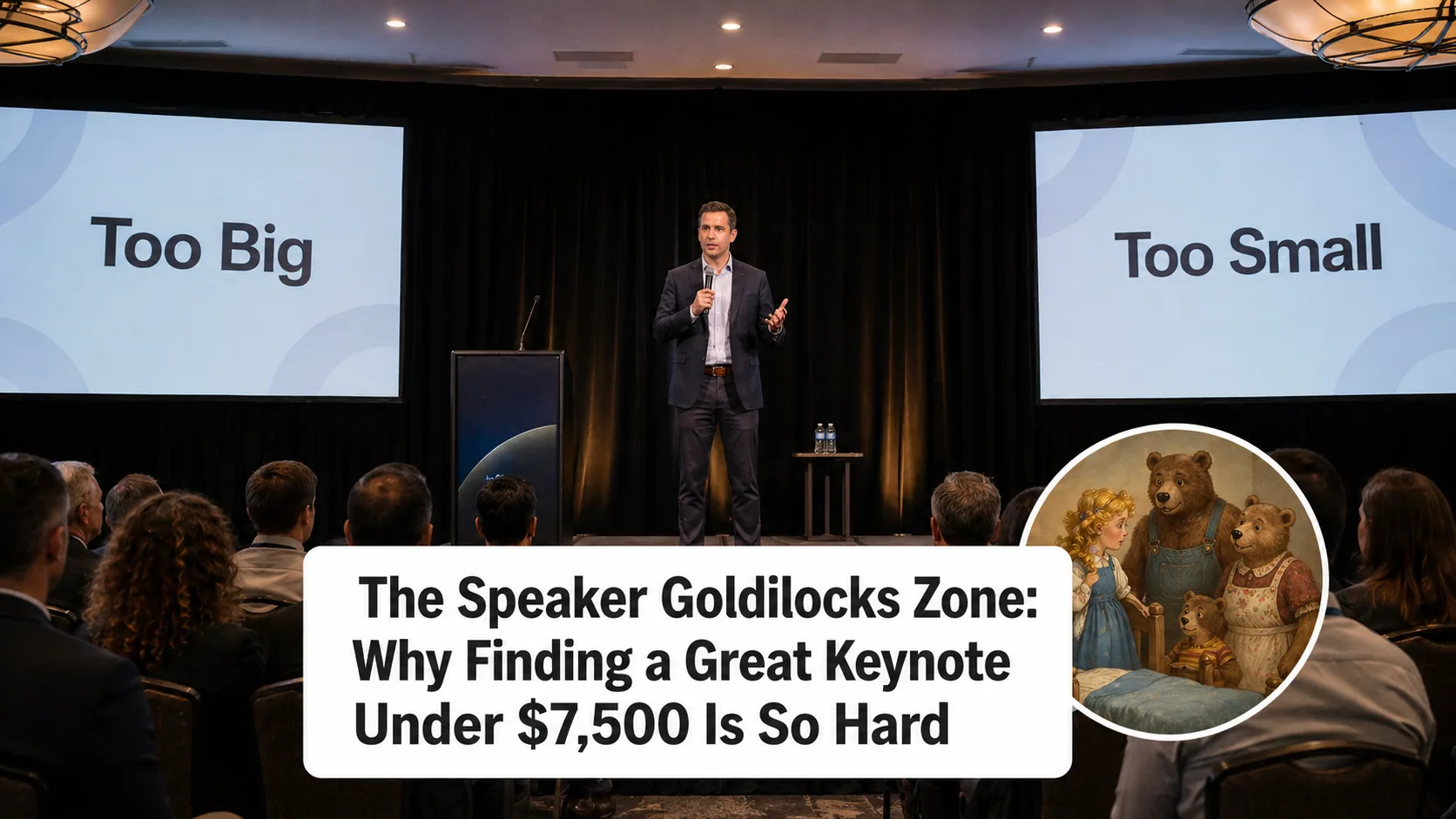
You are looking for the Speaker Goldilocks Zone.
Someone credible enough that they will command the attention of your audience, but not priced out of reach. Specific enough to be relevant, but not so niche that the room gets lost. Practical enough to be useful, but not so tactical that it feels like a breakout session. Polished enough to keynote, but still human enough to connect.
That is the speaker every planner wants.
And it is one of the hardest speakers to confidently find...until now?
The Budget Is Smaller. The Pressure Is Not.
There is a strange assumption people sometimes make about speaker budgets.
They assume a smaller fee means a smaller decision.
Every event organizer knows that is not how it feels.
A $7,500 keynote may not be a celebrity booking, but it is still a real investment. For many associations, nonprofits, annual conferences, and member-driven organizations, that money matters. The room still matters. The audience still has expectations. The board may still have an opinion. The executive director may still ask how the speaker was chosen.
And if the session misses, the planner still owns that debacle and it hurts because you don't have all the glitz and the glamour to make up for it. (Ok, my speaker may have sucked but have you seen my giant 20 foot ice sculpture outside that is creating individually branded and custom flavors of ice cream?)
A lower speaker fee does not lower the planner’s accountability.
Sometimes it makes the choice feel more exposed, because the planner cannot lean on fame as the safety net.
When the audience recognizes the name, some confidence comes pre-installed.
When they do not, the planner has to build confidence another way.
Every planner knows the moment.
You find someone who seems promising. The topic fits. The website looks solid. The video is good enough to keep watching. The bio has the right signals.
But you are still squinting at the screen, replaying the same two-minute clip, trying to answer the question the website cannot quite answer:
“Will this person actually work for our room and can I afford them?”
That is where the search gets hard.
The Old System Was Not Built For This Zone
For years, planners found speakers through the channels available to them.
Ask another planner. Ask the board. Ask your network. Search online. Attend conferences hoping to find your event hero. Look through tons of cold emails. Talk to a bureau.
All of those paths can work. But they are SOOOO time intensive and luck based.
By the way, good bureaus absolutely have a place in the industry. They know their trusted speakers. They help buyers narrow the field. They manage risk, relationships, contracts, expectations, and the small human details that come with live events.
I do not think bureaus are the villain here.
It is just math.
One bureau owner once said the quiet part plainly: lower-fee opportunities are often more work, less profit, and convert at a lower rate.
That was not said with malice. It was a practical statement about the business model.
A bureau may do similar work for a $50,000 speaker and a $7,500 speaker. The client still needs to be understood. The match still needs to be right. The details still need to be managed. The relationship still needs to be protected.
But the economics are completely different.
So the traditional high-touch model naturally gravitates toward larger fees. That is where it works best.
For planners under $7,500, the result is not a lack of options.
It is a thinner support system right at the moment when the decision still feels important.
When Your Network Becomes Your Search Engine
When the usual systems do not fully serve this range, planners do what planners always do.
They figure it out.
They text someone. They ask a colleague. They email the board. They search Google. They check LinkedIn. They open the old spreadsheet. They search their inbox for the word “speaker.” They look at someone who cold-emailed six months ago and wonder if maybe this is the time to reply.
None of this is wrong.
It's just time consuming like a mofo and based on luck, not trusted process.
When your budget is under $7,500, your network often becomes your search engine. Networks are useful, but they are not neutral.
They surface who is familiar. Who is nearby. Who someone happened to see recently. Who came to mind first. Who did well at a different event for a different audience.
Sometimes that produces a great match, if you're lucky.
And sometimes it misses the person who would have been perfect because no one in your circle had heard of them yet.
That is one of the quiet frustrations of this budget range.
The right speaker may exist. They may have the right topic, tone, presence, fee, and audience track record.
But if the search process cannot surface them, they are effectively invisible.
For example, at Talkadot, we match events to speakers using real data. An example was when Big I Michigan needed a speaker for their Insurance event and our platform was able to match them to Sandy Gerber. Sandy was a perfect fit but lived in Canada and no one on the team knew about her. But once they found her through Talkadot and saw her Talkadot Public Profile, it was a clear yes and she rocked the house, the client and her Talkadot data proved it!
More Options Did Not Fix The Problem
The internet was supposed to make this easier.
In some ways, it did.
You can find more speakers than ever. More websites. More demo reels. More LinkedIn profiles. More testimonials. More speaker pages. More people saying they are perfect for your event.
But more options are not the same as more confidence.
Sometimes they create the opposite.
Now the planner is not just asking, “Who is available?”
They are asking:
- Which of these people is actually good?
- Which one understands our audience?
- Which one can make this feel like a keynote, not a lecture?
- Which one will give us practical value without turning the opening session into a workshop?
- Which one will not make me regret this decision?
The internet gave planners more names. It did not give them a better way to know which names were worth trusting.
That is the missing piece >>> WORTH TRUSTING.
A speaker reel can help. A referral can help. A strong client logo can help. A good website can help. But let's be honest, who has time to do due diligence on randos on the internet?
Alone, those are all partial signals.
The question planners really want answered is much harder:
What happened in the room after this person spoke?
Did the audience care?
Did they feel understood?
Did they leave with something useful?
Did the speaker land with people like ours?
Did the session create energy, clarity, conversation, or action?
That kind of signal has been missing from most speaker searches, especially in the budget range where planners are often doing the most work themselves.
Why Audience Feedback Changes The Search
Audience feedback does not remove human judgment.
It gives human judgment something better to work with.
That matters most in the Speaker Goldilocks Zone, because many of the strongest speakers under $7,500 are not famous enough for name recognition to carry the decision.
They may be practitioners, facilitators, authors, professors, consultants, former executives, industry specialists, or rising keynote speakers. People with substance, experience, and real audience impact, but without the brand visibility that makes them obvious from the outside.
That does not make them lower quality.
It makes them harder to see.
Audience feedback helps solve that problem because it moves the question from:
“Who looks bookable?”
to:
“Who has actually resonated with real audiences like mine?”
That may sound like a subtle distinction, but it changes the entire feel of the decision.
A speaker outside your immediate network can become a credible option, not because they marketed themselves well, but because there is evidence that they have delivered value in real rooms.
For planners, that is the thing they are quietly searching for.
Not more names.
More confidence.
Why Talkadot Was Built This Way
This is one reason Talkadot exists.
Not to create another endless speaker directory. There are already enough places to browse.
Talkadot was built because planners do not need a bigger pile of names. They need a clearer way to find the right ones.
Over the last 4+ years, Talkadot has collected more than 1.5 million pieces of audience feedback from 40,000+ events across 12,000+ speakers.
That data makes a different kind of speaker discovery possible.
A planner can describe the audience, topic, goal, event type, and budget, and Talkadot surfaces speaker matches with a reason behind the recommendation.
The goal is to remove the scavenger hunt.
Instead of bouncing between websites, emails, reels, referrals, and team opinions, the planner can move from search to shortlist to outreach in one place.
The point is not to replace the planner’s judgment.
The point is to reduce the amount of guessing required before that judgment can happen.
And Talkadot is free for event planners to use.
That matters in this range. A planner looking for a strong keynote under $7,500 should not have to add another cost just to search with better confidence.
Talkadot is free for event planners, and when a successful new booking happens through the platform, Talkadot takes a small percentage from the speaker side.
For speakers, that can make sense too. If a platform brings them a qualified opportunity with a planner who is already interested, that is new business they likely would not have had otherwise.
The model works because it was built for a part of the market that has historically been too manual to serve well.
The Real Shift
Most annual conferences are not trying to book a household name.
They are trying to find the speaker who is right for their room.
That sounds simple until you are the person responsible for choosing.
Then you realize how much has to line up: credibility, relevance, delivery style, usefulness, budget, audience fit, professionalism, and that harder-to-name feeling of, “Do I trust this person with our audience?”
That is the Speaker Goldilocks Zone.
For many planners, it lives under $7,500.
The speakers are out there.
That was never the real problem.
The harder problem has been finding them, trusting them, and feeling confident enough to bring them in front of YOUR people.
Because finding a great keynote under $7,500 should not feel like luck.
It should feel like the search process finally understands how most annual conferences actually buy.